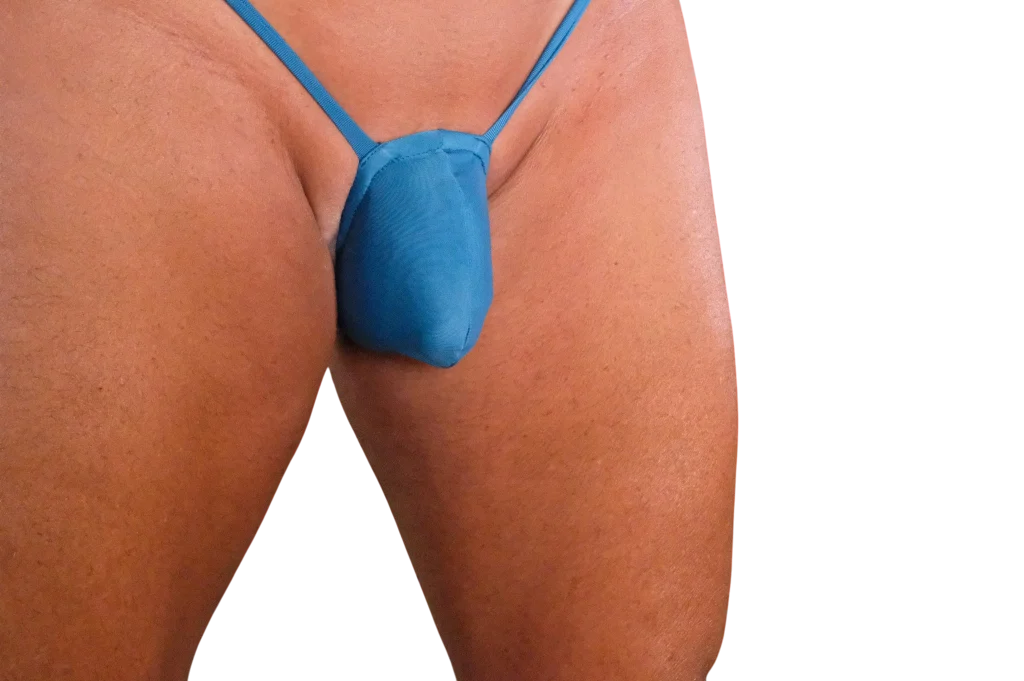
Spandex G-Strings Are the Smallest Swimsuits for Men and Women
Swimwear has been getting smaller for decades. Traditional one-piece suits gave way to bikinis, bikini bottoms became thongs, and thongs evolved into G-strings and micro designs that use remarkably little fabric.
For both men and women, the spandex G-string swimsuit represents one of the ultimate expressions of minimal swimwear.
A G-string eliminates nearly everything that isn’t necessary to keep a swimsuit in place. The sides become narrow strings or straps. The rear is reduced to a tiny panel or essentially a string. The front can shrink dramatically as well, particularly in modern micro and ultra-micro designs.
Add lightweight, highly stretchable spandex and the result can be a swimsuit that is astonishingly small while still functioning as swimwear.
What Is a Spandex G-String Swimsuit?
A G-string swimsuit is a minimal-coverage design consisting primarily of a front panel connected to very narrow side and rear straps.
The defining characteristic is the back.
A conventional bikini provides substantial rear coverage. A Brazilian bikini reveals more of the buttocks. A thong reduces the center back to a narrow strip. A G-string takes the concept to its logical conclusion by reducing the rear portion to a very narrow strap or string.
That makes the G-string one of the smallest established swimsuit silhouettes worn by both men and women.
Modern versions can go even further by dramatically reducing the front panel.
The resulting swimsuit may weigh very little, occupy almost no space in a suitcase, and produce some of the smallest possible tan lines.
Why Spandex Is Perfect for G-Strings
Stretch fabric made the modern G-string possible.
Spandex—also commonly associated with Lycra and elastane blends—can stretch significantly and recover its original shape. This allows designers to create extremely small swimsuits that conform closely to the body.
That matters enormously when there isn’t much fabric.
A loose-fitting conventional swimsuit has enough material to compensate for small changes in positioning. A micro G-string doesn’t.
Its few pieces of fabric have to do virtually all the work.
Quality stretch material allows the front to conform to the wearer while elasticized strings maintain tension around the hips.
Spandex also creates the smooth, body-hugging appearance that has become closely associated with tiny swimwear.
G-Strings for Women
Women’s G-string swimsuits have existed for decades and are a natural extension of thong bikinis.
The basic formula is simple: a small bikini front combined with almost no rear coverage.
There are nevertheless many variations.
Some have relatively conventional triangular bikini fronts with G-string backs. Others use tiny Brazilian-inspired fronts. String bikinis can incorporate adjustable tie sides, while micro versions may reduce the front to an exceptionally small triangle.
The attraction is straightforward.
A G-string provides maximum sun exposure and minimal tan lines while creating an unmistakably daring bikini aesthetic.
For people comfortable with revealing swimwear, there isn’t much left to eliminate.
G-Strings for Men
Men’s G-string swimwear has developed into an increasingly diverse category of its own.
Early men’s G-strings frequently used a fairly substantial anatomical pouch attached to extremely narrow strings. Contemporary designers have increasingly reduced the pouch as well.
The result is a spectrum ranging from relatively practical men’s G-strings to extraordinary micro designs.
A traditional men’s version may provide a shaped pouch with enough room for comfortable anatomical support.
A micro version reduces that pouch considerably.
An ultra-micro G-string can reduce almost every element of the swimsuit to its minimum practical dimensions.
This has helped eliminate the assumption that men’s swimsuits must provide more coverage than women’s.
In some cases, the opposite is now true.
A man in an ultra-micro G-string may be wearing substantially less material than a woman in a conventional bikini.
Men’s and Women’s G-Strings Are Moving Closer Together
One of the most interesting developments in minimal swimwear is the convergence of men’s and women’s silhouettes.
Put two conventional swimsuits beside each other and the differences can be obvious. Men’s swim briefs traditionally have shaped fronts and more substantial sides, while women’s bikini bottoms are typically cut around a different anatomy.
Shrink both garments into G-strings, however, and many of those visual differences begin disappearing.
Both can have:
- Tiny front panels
- String sides
- Virtually nonexistent backs
- High-cut legs
- Low-rise waists
- Minimal tan lines
- Stretch spandex construction
The remaining differences are often concentrated in the construction of the front.
Even that distinction is becoming less rigid as designers introduce gender-fluid, minimizing, contouring, and alternative pouch designs.
From Thong to G-String
People sometimes use “thong” and “G-string” interchangeably, but there is usually a difference.
A thong swimsuit generally has a narrow strip of material running between the buttocks and widening somewhat toward the waistband.
A G-string reduces that material further, often to little more than elastic or a fabric-covered string.
Think of it as a progression:
Traditional brief → bikini → Brazilian → thong → G-string → micro G-string.
Every step generally eliminates additional fabric.
The boundaries aren’t standardized, however, so manufacturers may use terms differently.
Then Came the Micro G-String
Once designers started creating G-string swimsuits, there was an obvious question:
How much smaller can they get?
The answer was the micro G-string.
A normal G-string already has almost no back. Consequently, designers seeking to reduce coverage further have to concentrate primarily on the front.
The front panel becomes narrower.
Then shorter.
The sides become extremely thin.
The waistband can become little more than a string.
Eventually the swimsuit reaches a point where there is almost nothing left to remove while still maintaining the intended amount of coverage.
This is where G-string swimwear meets the world of ultra-micro fashion.
Ultra-Micro G-Strings
Ultra-micro swimsuits take minimalism to its extreme.
Rather than asking how small a bikini can reasonably become, designers effectively ask:
What is the absolute minimum amount of fabric needed for this particular design?
For women, this can mean extremely tiny triangular or contoured fronts.
For men, it can mean extremely small pouch designs combined with string sides and backs.
These suits are less about traditional ideas of coverage and more about minimal fashion, tanning, body confidence, and making a dramatic statement.
Venue appropriateness becomes increasingly important at this end of the spectrum because an ultra-micro swimsuit accepted at one beach may violate the dress or coverage requirements of another.
Men’s Pouch G-Strings
An important distinction within men’s G-string swimwear is the pouch.
A conventional pouch is three-dimensional. Rather than compressing everything against the body, it provides room and support.
Pouch G-strings can therefore combine two seemingly opposite concepts:
Maximum anatomical support with minimum overall swimsuit coverage.
The entire garment may consist of little more than a pouch and three narrow straps.
This is one reason men’s G-strings can feel very different from simply wearing a women’s G-string.
The overall swimsuit is tiny, but its front is engineered specifically for the wearer’s anatomy.
Micro-Pouch G-Strings
Not every wearer wants a prominent pouch.
Micro-pouch G-strings intentionally reduce the apparent size of the front.
Some use smaller construction. Others rely on positioning, stretch, compression, or different seam arrangements to produce a more compact silhouette.
These designs can create an interesting contrast: the wearer still has an anatomically accommodating swimsuit, but the overall appearance is dramatically minimized.
For people interested in extremely small men’s swimwear, the micro pouch can be one of the most distinctive G-string variations.
Gender-Fluid G-Strings
G-strings are also particularly well suited to gender-fluid swimwear.
Because the silhouette is already so stripped down, designers can alter the front construction without changing the fundamental appearance of the swimsuit.
A G-string can therefore be masculine, feminine, or deliberately difficult to categorize.
Some designs emphasize a pouch.
Others minimize it.
Some use compression for a smoother appearance.
Others borrow directly from traditionally feminine bikini styling.
This flexibility makes the G-string an interesting example of how modern swimwear is moving beyond rigid men’s and women’s categories.
The Smallest Tan Lines
Minimal tan lines are one of the most practical reasons people choose G-string swimwear.
A conventional swimsuit can leave substantial untanned areas around the hips and buttocks.
A G-string dramatically reduces them.
String sides create very narrow hip lines, while the G-string rear leaves almost the entire buttocks exposed to the sun.
Micro versions reduce the front tan line as well.
Anyone tanning in minimal swimwear should still use appropriate sun protection. Areas normally covered by clothing can burn particularly quickly when suddenly exposed.
Why People Love Tiny Swimwear
There isn’t one universal reason.
Some people simply like the appearance.
Others want better tanning.
Some enjoy the sensation of wearing almost nothing.
For athletes and people proud of their physiques, minimal swimwear leaves the body almost completely visible.
Others enjoy challenging traditional expectations about what men or women are “supposed” to wear.
For a first-time wearer, putting on a G-string can also create an enormous feeling of freedom precisely because it is so different from conventional swimwear.
G-Strings and Body Confidence
You don’t need a stereotypical “beach body” to wear a G-string.
That idea is increasingly outdated.
People have different ages, shapes, heights, weights, proportions, and levels of muscularity. Swimwear isn’t something you earn after achieving a particular body.
What matters more with an extremely small swimsuit is comfort and fit.
A person who genuinely enjoys their G-string will usually look more comfortable than someone wearing a supposedly “safe” swimsuit they dislike.
Men Are Discovering How Small Swimwear Can Be
The men’s swimwear market has changed particularly dramatically.
For decades, men’s beachwear was dominated by trunks and board shorts. Even a traditional racing brief could attract attention in places where loose shorts were the norm.
That is no longer the only choice.
Men can now choose among swim briefs, bikinis, Brazilian cuts, thongs, G-strings, pouch micros, string micros, and ultra-micro swimsuits.
This progression has created something unusual in mainstream fashion:
Men can now choose swimwear that is every bit as small as women’s swimwear—and sometimes smaller.
A tiny G-string demonstrates this perfectly.
The question is no longer whether men’s swimwear can become as minimal as women’s.
It already has.
Choosing Your First G-String Swimsuit
Someone trying a G-string for the first time doesn’t necessarily need to begin with an ultra-micro design.
A relatively substantial G-string can make an excellent introduction.
Look for secure side straps, adequate front coverage, quality stretch material, and a size appropriate for your body.
Once that feels comfortable, you can decide whether you want less coverage.
The progression might be:
Bikini → thong → G-string → micro G-string → ultra-micro G-string.
There is no obligation to continue shrinking your swimsuit, though.
Your ideal design is simply the one you enjoy wearing.
Fit Is Critical
The less fabric a swimsuit contains, the more important fit becomes.
An oversized micro swimsuit may shift unexpectedly. An undersized one may not provide the coverage the wearer expects.
A good G-string should remain comfortably positioned during ordinary activities such as walking, sitting, swimming, and getting in or out of the water.
Pay particular attention to stretch.
A swimsuit that fits perfectly when dry can behave somewhat differently when wet.
Before wearing an extremely small design publicly, test it in the shower or a private pool and move around normally.
Check the Rules Before Going Ultra-Micro
Minimal swimwear isn’t appropriate or permitted everywhere.
Rules differ among public beaches, private beaches, hotels, resorts, cruise ships, pools, gyms, and clothing-optional destinations.
A normal G-string may be acceptable at one location while an ultra-micro version isn’t.
The issue is generally coverage rather than the gender of the wearer.
If a venue has minimum-coverage rules, they apply regardless of whether the person wearing the swimsuit is male or female.
When in doubt, check before arriving.
The Ultimate Minimal Swimsuit
There will probably always be designers trying to create something smaller.
Nevertheless, the G-string occupies a special position in swimwear because there is simply so little garment remaining.
The rear has essentially been reduced to a string.
The sides can be strings.
That leaves the front as the primary area designers can continue shrinking.
At the extreme end, an ultra-micro spandex G-string can therefore approach the practical limits of conventional minimal swimwear.
And that applies to everyone.
Spandex G-Strings Have Become Truly Unisex Minimal Swimwear
Perhaps the most interesting thing about the modern G-string is how effectively it crosses traditional gender boundaries.
Women helped establish thong and G-string swimwear as recognizable beach fashions.
Men increasingly adopted the same minimalist principle and pushed men’s designs into bikinis, thongs, G-strings, micros, and ultra-micros.
Gender-fluid fashion has blurred those categories even further.
The result is remarkably simple:
Tiny swimwear belongs to everyone.
A woman can wear a micro G-string.
A man can wear a micro G-string.
A trans or nonbinary person can wear one.
Someone can choose a swimsuit with an anatomical pouch, a minimizing front, a flat silhouette, or another form of construction that suits their body and desired presentation.
The G-string doesn’t dictate who you are.
It is simply one of the smallest swimsuits you can wear.
Final Thoughts: How Small Can Swimwear Go?
From bikinis to thongs and from thongs to G-strings, swimwear has repeatedly demonstrated that designers can accomplish a surprising amount with very little fabric.
Spandex makes that experimentation possible.
Its stretch, recovery, and body-conforming properties allow a swimsuit to become extraordinarily small while still remaining recognizable as swimwear.
For women, G-strings represent the extreme edge of traditional bikini minimalism.
For men, they have helped create a rapidly expanding world of micro and ultra-micro swimwear that can be every bit as revealing as the smallest women’s designs.
And for everyone between or beyond those categories, G-strings offer an almost inherently gender-fluid canvas.
Bikinis are small.
Thongs are smaller.
But when almost the entire swimsuit has been reduced to a tiny front and a few narrow strings, you’ve reached one of the ultimate expressions of minimal swimwear:
the spandex G-string.